Position statements

Amendments to the Fire and Rescue NSW Regulation 2023, including changes to fee structure and prices, come into effect from 1 February 2026. Under these regulations, an upfront assessment fee must be paid prior to submitting a fire safety application or request.

To facilitate the processing of the assessment fee ahead of the application, and not cause delay to your application timeframes, please commence the payment process four working days before the application is to be lodged. Applications will not be processed unless the assessment fee has been paid in full.

Visit Pay upfront fee for further information.

These are our formal positions in regard to each given matter. We provide them in the public interest even though we may not have any specific jurisdiction on the matter. However, a responsible person or authority may be expected to take into consideration any such relevant advice as appropriate to their given circumstance.

Accessibility of fire hydrants

FRNSW requires fire hydrants to be always accessible, and will comment on hydrant accessibility in reports issued under s28, s50 and s51 of the Environmental Planning and Assessment (Development Certification and Fire Safety) Regulation 2021.

Hydrant accessibility is determined by the applicable fire hydrant system Standard. However, FRNSW offers additional clarification on accessibility applying to any street fire hydrants or large-bore suction connections that are part of the fire hydrant system.

All proponents, including consent authorities (e.g. Council) determining the initial development application, are to consider the implications of fire hydrant accessibility and the potential loss of street parking and/or easement access necessary to required hardstands, especially for any large-bore suction connections that is required by the hydrant system.

Position statement summary

Updated: 29th April 2024

Applicable Building Code of Australia (BCA)

FRNSW will not determine or advise on the Building Code of Australia (BCA) edition to use for any building or project. The certifier is responsible for determining the applicable edition of the BCA, including for staged building work.

Certifiers are expected to apply the In force Environmental Planning and Assessment (Development Certification and Fire Safety) Regulation 2021, including any Savings and Transitional Provisions as relating to the application date.

Further guidance can be obtained from NSW Fair Trading at https://www.fairtrading.nsw.gov.au/trades-and-businesses/business-essentials/building-certifiers/certifier-responsibilities.

Position statement summary

Updated: 29th April 2024

Application of fire sprinkler concessions under Specification 18 of the NCC

FRNSW interpret the application of the automatic fire sprinkler system concessions under S18C4 of Specification 18 of the National Construction Code (NCC) to only apply to buildings that contain Class 2 or 3 only.

It is the view of FRNSW that these concessions do not apply to other building classes, including multiple classification buildings, such as a Class 2 or 3 building that contains Class 5, 6, 7, 8, 9a or 9b parts.

Note: Permitted concessions, such as the dry fire hydrant concession, do not apply to a multiple classification building.

Whilst FRNSW acknowledges that an FPAA101D and FPAA101H automatic fire sprinkler system are permitted to be installed, in certain circumstances, the concessions identified above do not apply.

Reference should also be made to the FRNSW position Fire sprinklers in Class 2 and 3 buildings.

Position statement summary

Updated: 30th August 2024

Automated vehicle parking system/s (AVPS)

FRNSW endorse the guideline Fire Safety Requirements for Automated Vehicle Parking Systems as published by the Australasian Fire and Emergency Service Authorities Council, as the appropriate guidance to practitioners who design and certify any building that incorporates an automated vehicle parking system/s (AVPS) such as a ‘car-stacker’.

FRNSW consider any AVPS comprising three or more vertically stacked cars to be a special hazard under E1D17 and E2D21 of the National Construction Code (NCC) 2022. As such, the certifier should identify what additional provisions are being provided, if any, and whether the fire safety measures in the building are commensurate to the hazard and risk(s) associated with the proposed AVPS, when certifying any related building application.

Position statement summary

Updated: 29th April 2024

Automatic storage and retrieval systems (ASRS)

Building proponents must address the fire safety and other risks associated with the storage of flammable goods (dangerous goods class 2, 3 and 4) within any top loading ASRS. The risk mitigation measures should be documented as part of the design and approval process, including any Preliminary Hazard Analysis and Fire Safety Study undertaken.

FRNSW also recommend consideration be given to Appendix C.3 “Automatic storage and retrieval systems” of AS 2419.1:2021 – Fire hydrant installations, Part 1: System design, installation and commissioning, when designing fire protection systems in buildings that contain an ASRS.

Position statement summary

Updated: 5th December 2024

Consultation on the performance-based design brief (PBDB)

When a development proposes to incorporate performance-based design for any fire safety requirement, whether a building design having a performance solution in accordance with the National Construction Code (NCC) Volume 1 (Class 2 to 9 buildings) or other infrastructure where building codes are not applicable, FRNSW must be engaged in the PBDB process as a stakeholder.

Note 1: Under s26(1) of the Environmental Planning and Assessment (Development Certification and Fire Safety) Regulation 2021, the owner of a building must ensure that the person who develops a PBDB for a performance solution for a fire safety requirement in the building requests the Fire Commissioner’s comments on the brief if—

(a) the building is a class 2, 3, 4, 5, 6, 7, 8 or 9 building, and

(b) a construction certificate is required for the building work comprising the performance solution.

Note 2: Under s26(2) of the Environmental Planning and Assessment (Development Certification and Fire Safety) Regulation 2021, the request for consultation must be made—

(a) during the development of the performance-based design brief, and

(b) in the way required by the Fire Commissioner.

Note 3: With regards to A2G2(4)(a) in NCC Volume One, which requires consultation with relevant stakeholders during the PBDB, FRNSW consider that for Class 2 to 9 developments within NSW the relevant fire service/brigade is a relevant stakeholder in all Performance Solutions relating to fire safety.

Note 4: Guidance on the development of a PBDB is presented in the Australian Fire Engineering Guidelines (AFEG), as identified by the NCC.

FRNSW requires the request for PBDB consultation be made via written application using the Performance-based design brief (PBDB) consultation form available at www.firesafety.fire.nsw.gov.au. All building proponents are reminded that a Performance Solution cannot be developed and applied retrospectively to existing buildings or completed building works, therefore consultation will not be provided on any proposal where no building work is proposed.

Note: Reference should be made to the FRNSW position Fire engineering for existing buildings.

Position statement summary

Updated: 30th August 2024

Consultation with the relevant fire brigade, fire service or fire authority

Any formal consultation required to be made with the relevant fire brigade, service or authority, when concerning any matter of the built environment as pertaining to statutory fire safety provisions, is to be made to Fire and Rescue NSW (FRNSW) via written application to the Fire Safety Branch. A written application can be made using the relevant application form available at www.fire.nsw.gov.au/firesafety.

Consultation with FRNSW extends to any formal comment being sought on matters relating to other Statutes and referenced provisions, including on the National Construction Code and referenced Standards.

However, consultation with FRNSW does not extend to matters where another agency is identified as being the agency having jurisdiction (e.g. the NSW Rural Fire Service has jurisdiction over certain matters for development on bush fire prone land).

Under no circumstances should formal consultation be sought from any local fire brigade stations on any statutory fire safety provision matter. The Fire Safety Branch act on behalf of the FRNSW Commissioner under delegated authority.

Position statement summary

Updated: 29th April 2024

Dry fire hydrant system

FRNSW endorse the guideline Design, Installation and Maintenance Requirements for Dry Hydrants as published by the Australasian Fire and Emergency Service Authorities Council, as guidance to practitioners who design, install and maintain an internal dry fire hydrant system within any building.

The following must be considered when an internal dry fire hydrant system is being installed:

  • The system can only be installed in a Class 2 or Class 3 building only; the National Construction Code (NCC) does not allow dry fire hydrants to be installed in multiple Classification buildings (i.e. a single or united building cannot have both a wet and dry fire hydrant system installed).
  • The system necessitates different design considerations to a wet fire hydrant system; a dry hydrant system is not a wet system emptied of water thus may have other non-compliances to AS 2419.1.
  • The system performance depends on the sprinkler system installed and any corresponding concession that is permitted under the NCC.
  • The system design may apply any fire hydrant flow concession across the number of hydrants required to flow, as determined by AS 2419.1 (e.g. 1 = 6 L/s, 2 = 12 L/s etc.).
  • The system can comprise internal hydrants only; dry external attack fire hydrants are not permitted in the system’s design.
  • The system must be left dry post any commissioning or testing; any dry fire hydrant system containing residual water due to improper drainage may be identified as being non-compliant.
  • The system may only comprise a street fire hydrant if the hydrant is within 60 m and is fully accessible; if the street fire hydrant is not fully accessible then a feed hydrant must be installed and located as part of the fire brigade booster assembly.

Note: an internal dry fire hydrant system cannot be installed if the statement of available pressure and flow from the water network utility operator shows insufficient performance for the design; the internal dry fire hydrant system cannot incorporate tanks and/or pumps into the design.

Position statement summary

Updated: 4th June 2024

Electric vehicles (EV) and EV charging equipment

FRNSW endorse the position on Electric Vehicles (EV) and EV charging equipment in the built environment as published by the Australasian Fire and Emergency Service Authorities Council (AFAC), as the appropriate guidance to practitioners who design and certify any Class 2-9 building that incorporates EV parking and/or charging.

FRNSW consider EVs and EV charging stations to be special hazards under E1D17 and E2D21 of the National Construction Code (NCC) 2022. As such, the certifier should identify what additional provisions are being provided, if any, and whether the fire safety measures in the building are commensurate to the hazards and risk(s) associated with the proposed EV parking and/or charging, when certifying any related building application.

Note: FRNSW considers incidents involving electric vehicles (EVs) and EV infrastructure to currently be low frequency, but potentially high consequence, incidents that require enhanced fire safety measures in place to facilitate safe and effective fire brigade operations.

FRNSW consider that all aspects of the AFAC Position should be considered and addressed. In conjunction with the AFAC position, FRNSW recommend that EV parking and/or charging be:

  • located externally or in open air where possible.
  • if located internal to a building, the carparking area should:
    • be protected by an automatic fire sprinkler system with a performance equivalent to a system complying with AS 2118.1 or AS 2118.6; and
    • not apply concessions to fire resistance levels (FRLs) that may be provided within the NCC deemed-to-satisfy provisions.
  • protected by fire hydrant coverage.

Any request for consultation or referral to FRNSW relating to any building that intends to incorporate EV parking and/or charging, should adequately identify the hazards and risks and demonstrate how they are being addressed within the design. The ‘recognised person’ should address the special hazards and how the provisions of this position statement and the AFAC Position have been considered and addressed.

Note: A ‘recognised person’ means a person who is both an accredited practitioner (fire safety) and a fire safety engineer under the Environmental Planning and Assessment (Development Certification and Fire Safety) Regulation 2021.

Position statement summary

Updated: 4th June 2024

Emergency plan requirements at sites having lithium batteries

When a site or premises has a combined total of 25,000 kg or more of lithium batteries being used, handled, stored or installed, FRNSW recommend the site satisfy the requirements of clause 361 of the Work Health and Safety Regulations 2017 (WHS Reg.).

Note: FRNSW consider the fire and life safety risk from bulk quantity of lithium batteries to be commensurate with manifest quantity hazardous chemicals.

Reference to lithium batteries includes lithium-ion, lithium-ion polymer and lithium metal polymer batteries, whether being standalone or integrated into a battery pack or system such as a battery energy storage system (BESS). Lithium batteries incorporated into electric vehicles and/or plant are included in the combined total if they are associated with the site or premises (e.g. owned, managed, stored or charged on the site).

In satisfying clause 361, the person conducting a business or undertaking (PCBU) of any applicable site or premises should lodge a copy of the emergency plan with FRNSW, which includes:

  • the emergency plan developed under clause 43 of the WHS Reg.
  • an Emergency Services Information Package (ESIP) prepared in accordance with FRNSW fire safety guideline Emergency services information package and tactical fire plans, available at fire.nsw.gov.au. The ESIP should include the following relevant information:
    • a site plan which identifies the location, battery type or chemistry, and quantities of lithium batteries located on the site
    • details of all associated fire safety measures and containment features of the site, and included within the tactical fire plans as appropriate
    • a copy of the battery manufacturer’s recommendations including any isolation or shutdown procedures, and appropriate extinguishment method
    • relevant and current Safety Data Sheets (SDS) for the lithium batteries at the site.

Any written recommendations made by FRNSW on the emergency plan, including within the ESIP, should be incorporated within the final emergency plan for the site.

Note: The relevant consent or regulatory authority may impose this position as a condition upon the PCBU (i.e. to submit a copy of the emergency plan and ESIP to FRNSW).

Position statement summary

Updated: 5th December 2024

Exemption from fire safety standards

FRNSW will not grant any exemption from fire safety standards, made under s111 of the Environmental Planning and Assessment (Development Certification and Fire Safety) Regulation 2021, that involves the total deletion of any required hydraulic Category 3 fire safety provision (e.g. a required fire hydrant system).

Note: Total deletion of any hydraulic fire safety provision required by the National Construction Code would not be considered reasonable nor necessary.

Refer to Fire safety exemption for further information on the exemption process, including how to apply and other restrictions when an exemption cannot be granted.

Position statement summary

Updated: 29th April 2024

Extended fire hydrant coverage

FRNSW may consider a performance solution seeking equivalent or comparative fire hydrant coverage to AS 2419.1:2021, particularly when an existing fire hydrant system meets a different standard of performance (e.g. AS 2419.1-2005, Ordinance 70). The performance solution must demonstrate how fire hydrant coverage meets the operational needs of the fire brigades and facilitates safe and effective firefighting.

Note: For existing buildings with an Ordinance 70 fire hydrant system, reference should also be made to the FRNSW position Fire hydrant system in existing building or premises.

Performance solutions for extended fire hydrant coverage are assessed on a case-by-case basis. Any proposal for extended fire hydrant coverage must be clearly shown on floor and/or site plans that show the hydrant outlet location and coverage arcs of the extended coverage.

Position statement summary

Updated: 14th June 2024

External combustible cladding

FRNSW will consider cladding risk assessment principles when asked to provide advice in respect of buildings that have external combustible cladding (“Cladding”).

Refer to External combustible cladding for further information.

Position statement summary

Updated: 14th June 2024

Fire brigade booster operating pressure

FRNSW requires the fire brigade booster installed on a fire hydrant or fire sprinkler system to have a ‘PN’ rating not less than the fire brigade boost inlet pressure necessary to operate the most hydraulically disadvantaged outlet/s, including when in full-flow bypass mode.

Table 1.1 of AS 2419.3-2012 identifies both ‘allowable operating pressure’ and ‘maximum allowable operating pressure’ for each PN rated fire brigade booster. The fire brigade booster on any given fire hydrant system must have an allowable operating pressure not less than the maximum design fire brigade boost pressure of the hydrant system.

Note: The higher maximum allowable operating pressure allows for intermittent and sporadic pressure surges or spikes (e.g. water hammer).

Reference should also be made to FRNSW position FRNSW pump performance for high rise buildings. The maximum design fire brigade boost pressure should exclude any fire hydrant pumpset input (i.e. the fire brigade booster is operating in full-flow pumpset bypass mode).

Position statement summary

Updated: 5th December 2024

Fire doors with fire activated retaining devices (e.g. bolts)

FRNSW require fire doors to remain functional (i.e. openable and closeable) for the duration of any fire to allow safe evacuation of occupants and to facilitate fire brigade intervention. Fire doors should not be fitted with supplementary fire activated retaining devices that render the door inoperable once activated by fire.

Note: Clause 2.1.4.1 of AS 1905.1:2015 Components for the protection of openings in fire-resistant walls Part 1: Fire-resistant doorsets states all hardware shall function so that the door leaf is self-latching; fire activated retaining devices are not self-latching.

FRNSW understand that fire activated retaining devices, such as fire bolts, are being installed within some fire resisting doorsets to allow the door to pass the fire resistance requirements of AS 1530.4:2014 Methods for fire tests on building materials, components and structures, Part 4: Fire-resistance tests for elements of construction.

Fire activated retaining devices are supplementary hardware that latch the door leaf to the frame when activated by fire and can be triggered by various means (e.g. intumescent, fusible link, magnetic), and secure the door shut to minimise warping and ensure integrity.

However, if these devices activate prior to or during occupant evacuation or fire brigade intervention then Performance Requirement D1P2 of the National Construction Code (NCC) is not being satisfied as occupants may have their egress impeded or become trapped in the building and fire brigade intervention may be impeded.

Note: Fire activated retaining devices may trigger early during fire, or even prior through unintended deployment, and render the door inoperable well within the maximum duration of the door’s corresponding fire test period.

Certifiers must ensure that Performance Requirement D1P2 is being satisfied to ensure fire doors remain readily openable by a person seeking egress or by firefighters undertaking intervention. Reliance should not be solely placed on AS 1530.4:2014 test reports as evidence of suitability.

Position statement summary

Updated: 23rd December 2024

Fire engineering for existing buildings

Any proposal to implement a fire engineering strategy to address any building defect or other non-compliant element of an existing building must be done through an appropriate pathway under the Environmental Planning and Assessment Act 1979 (EP&A Act). Proponents should establish the appropriate pathway with the relevant regulatory authority (e.g. Council) in the first instance.

An assessment on the provision for fire safety can be undertaken by a recognised person and a fire engineering strategy developed that includes a holistic fire engineering assessment of the applicable matters.

Note: A ‘recognised person’ means a person who is both an accredited practitioner (fire safety) and a fire safety engineer under the Environmental Planning and Assessment (Development Certification and Fire Safety) Regulation 2021 (EP&A(DCFS) Reg.).

FRNSW may offer comment on any proposed fire engineering strategy for an existing occupied building only when the request is made by the relevant regulatory authority (e.g. Council) responsible for determining the matter. Any such request made to FRNSW must include the fire engineering assessment by the recognised person (i.e. the Fire Engineering Report).

Note: The regulatory authority can request comment from FRNSW on a proposed fire engineering strategy using the Comment on an occupied building form available at www.fire.nsw.gov.au/firesafety.

However, FRNSW will not determine or consult with any other stakeholder (e.g. fire engineer, building code consultant, certifier, architect, fire services consultant, etc.) on any fire engineering strategy proposed to address any fire safety order issued under Division 9.3 of the EP&A Act. In such cases, the relevant regulatory authority (e.g. Council) is responsible for determining or advising on the matter.

Position statement summary

Updated: 12th September 2024

Fire hydrant system - single vs multiple

Performance requirement E1P3 of the National Construction Code (NCC) states that a fire hydrant system (singular) is to be provided to the degree necessary to, amongst other things, facilitate the needs of FRNSW appropriate to firefighting operations.

A single or united building having multiple hydrant systems does not facilitate firefighting operations, including incorporating differing design standards such as both a wet and dry fire hydrant systems.

Position statement summary

Updated: 9th October 2024

Fire hydrant system in existing building or premises

When a consent authority (e.g. Council) is assessing the adequacy of an existing fire hydrant system installed in accordance with the provisions of Ordinance 70 and Ministerial Specification 10 (or earlier), FRNSW recommend that the system be upgraded to meet the requirements of AS 2419.1:2021 to facilitate the needs of FRNSW appropriate to firefighting operations.

Additionally, any existing fire hydrant system that incorporates an internal booster connection for portable relay pumps (e.g. under Ordinance 70, AS 2419.1–1994) should be upgraded to remove the portable relay pump connection.

FRNSW acknowledge that all aspects of AS 2419.1:2021 may not be able to be complied with due to the characteristics and constraints of the existing fire hydrant system and/or building or premises. A bespoke upgrade solution may be required.

Note: There are differences between design standards which may make upgrading some requirements to comply with the latest Standard impractical.

Position statement summary

Updated: 12th September 2024

Fire hydrant system in new building or premises

FRNSW endorse AS 2419.1:2021 for the design and installation of fire hydrant systems in new building or premises. If the new building or premises is outside the scope of AS 2419.1:2021, which includes either of the following:

  • Class 7b or 8 building having a total volume more than 108,000 m3
  • automatic racked storage system (i.e. an Automatic storage and retrieval system)
  • a building having an effective height more than 135 m
  • a building or associated areas that include any special hazards,

then a performance solution is required to be developed for the fire hydrant system with consultation sought from FRNSW.

FRNSW recommend consideration be given to Appendices C, D and E of AS 2419.1:2021, when developing these performance solutions.

Position statement summary

Updated: 30th August 2024

Fire hydrant system signage

FRNSW require any new or upgraded fire hydrant system to be provided with signage that complies with, or is commensurate to, section 11.3 of AS 2419.1:2021.

Additionally, the fire hydrant system should be provided with the following supplementary signage (as required) to facilitate the needs of FRNSW.

Note: All additional signage is required to be permanently affixed, fade and weather resistant, with contrasting uppercase lettering as consistent with AS 2419.1:2021.

Additional internal fire hydrant

Any additional internal fire hydrant installed on a fire hydrant system to provide hydrant coverage must be provided with a location plan as per section 11.6 of AS 2419.1:2021.

The plan is to be oriented in the manner that reflects the aspect as presented to the reader and include a brief description of the hydrant’s relative location, not less than 15 mm high.
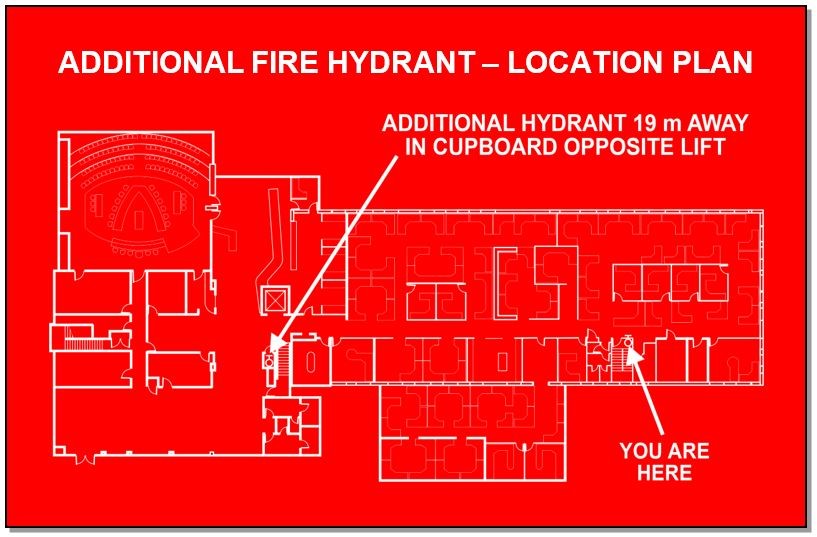
Additional fire hydrant - Location plan signage

Note: This sign informs firefighters on the location of an additional internal fire hydrant which can be utilised to attack fire not readily covered by the internal fire hydrant at which the sign is located (e.g. this sign is typically located adjacent to the fire hydrant valve).

Attack fire hydrant within 5 m of a fire brigade booster assembly

Any attack fire hydrant located within 5 m of a fire brigade booster assembly, irrespective of whether within a cabinet, enclosure or recess as per section 11.3.2 of AS 2419.1:2021 or not, must have a sign which states ‘ATTACK FIRE HYDRANT’, not less than 25 mm high.
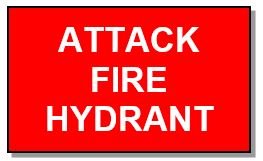
Attack fire hydrant signage

Note: This sign assists firefighters identify the attack fire hydrant, particularly when located in a cabinet, enclosure or recess with the fire brigade booster assembly.

Dry fire hydrant system fire brigade booster connection

Any fire brigade booster connection installed on a dry fire hydrant system must have a sign which states, ‘DRY FIRE HYDRANT’ and ‘FILL SYSTEM BEFORE BOOSTING TO WORKING PRESSURE BEFORE USING’, not less than 25 mm high.

If the fire brigade booster connection is fed by a street fire hydrant, the sign must also include ‘STREET HYDRANT’ and ‘HP’ or ‘HR’ depending on whether located on the Road or Path, and arrows to each side along with the respective distance to the street fire hydrant in that direction.

Note: A lowercase ‘m’ should be used for the unit of measurement of meters.
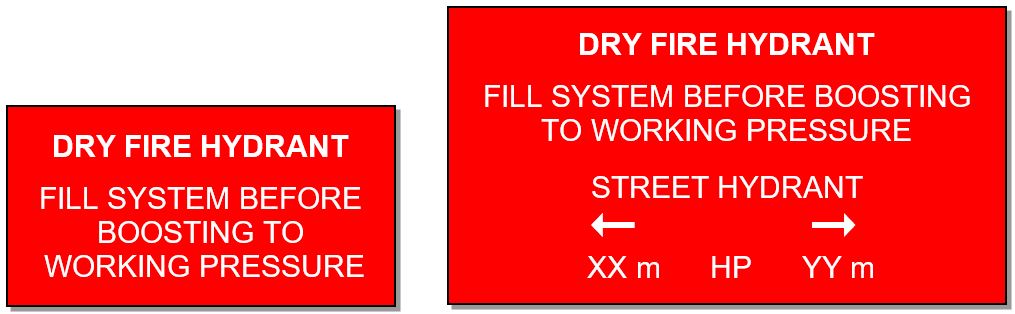
Dry fire hydrant signage

Note: This sign informs firefighters the internal fire hydrant is dry, and the system must be filled before using, as opposed to a wet and fully automatic fire hydrant system. The additional street hydrant information directs firefighters where the required water supply is located as feed fire hydrants are not provided as part of the fire brigade booster assembly.

Dry fire hydrant valve outlet

Any internal fire hydrant valve outlet installed on a dry fire hydrant system must have a sign which states, ‘DRY FIRE HYDRANT’ and ‘BOOST SYSTEM BEFORE USING’, not less than 25 mm high.
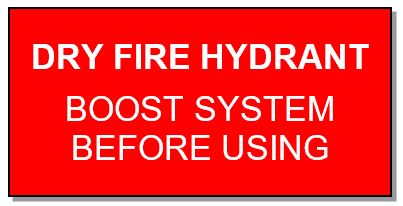
Dry fire hydrant signage

Note: This sign informs firefighters the internal fire hydrant is dry, and the system must be boosted before using, as opposed to being a wet and fully automatic fire hydrant system. FRNSW only requires the lettering height be not less than 25 mm, instead of 50 mm as nominated in the guideline Design, Installation and Maintenance Requirements for Dry Hydrants as published by the Australasian Fire and Emergency Service Authorities Council (AFAC).

Extended coverage from an external attack fire hydrant

Any external attack fire hydrant that provides extended hydrant coverage must have a sign which states:

(a)           ‘ATTACK FIRE HYDRANT’, not less than 25 mm high, and

(b)           ‘ADDITIONAL HOSE LENGTHS MAY BE REQUIRED’, not less than 15 mm high.
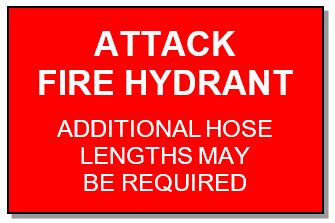
Attack fire hydrant signage

Note: This sign informs firefighters that the number of hoses required to provide fire hydrant coverage from the external attack fire hydrant exceeds AS 2419.1 requirements.

Extended coverage from an internal fire hydrant

Any internal fire hydrant that provides extended hose coverage must have a sign which states ‘ADDITIONAL HOSE LENGTHS MAY BE REQUIRED’, not less than 15 mm high.
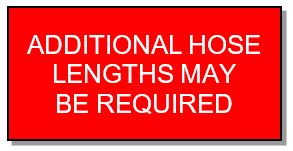
Additional hose length signage

Note: This sign informs firefighters that the number of hoses required to provide fire hydrant coverage from the internal fire hydrant exceeds AS 2419.1 requirements.

Extended coverage from an external feed or feed/attack fire hydrant

Any external feed or feed/attack fire hydrant that provides extended hose coverage from the fire brigade pumping appliance on the designated hardstand must have a sign which states:

(a)           ‘FEED FIRE HYDRANT’ or ‘FEED/ATTACK FIRE HYDRANT’, not less than 25 mm high, and

(b)           ‘ADDITIONAL HOSE LENGTHS MAY BE REQUIRED’, not less than 15 mm high.
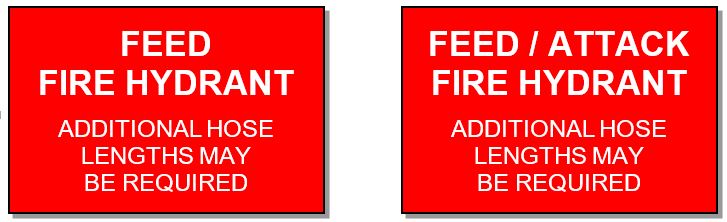
Feed hydrant signage

Note: This sign informs firefighters that the number of hoses required to provide fire hydrant coverage from the fire brigade pumping appliance that is connected to the feed or feed/attack hydrant exceeds AS 2419.1 requirements.

Street fire hydrant water supply for new and existing buildings

Any new or existing fire hydrant system that incorporates a street fire hydrant water supply should have a location plan as detailed by section 11.7 of AS 2419.1:2021.

Note: This sign informs firefighters that the fire hydrant system is being supplied by a street fire hydrant instead of feed fire hydrants as part of the fire brigade booster assembly.

Small-bore suction connection outlets

Any small-bore suction connection outlets fitted to a fixed suction connection, whether a ‘tank connection’ or ‘draughting point’, the small-bore outlets should have a sign which states ‘RFS USE ONLY’, not less than 25 mm high.

RFS use only signage

Note: This sign informs firefighters that the small-bore suction outlets, as detailed by section 5.3.1.3 of AS 2419.1:2021, are provided for use by NSW Rural Fire Service fire brigade appliances. Reference should also be made to the FRNSW position Small-bore suction connections.

Miscellaneous signage

Where specific information is required for firefighters to safely and effectively operate the fire hydrant system, or any component of, then concise and unambiguous supplementary signage is to be provided consistent with AS 2419.1:2021 and this position statement. Consultation should be sought from FRNSW on miscellaneous signage that may be required for a non-standard fire hydrant system.

Note: Examples of miscellaneous signage include any specific information relating to a performance solution variation, alternative location, non-standard operating procedure, wet/dry interfacing limitation, supplemental redundancy measure, etc.

Position statement summary

Updated: 5th December 2024

Fire safety in early childhood centres

FRNSW consider children within an ‘early childhood centre’, as defined by the National Construction Code (NCC), to be ‘vulnerable occupants’ due to their need for assisted evacuation in the event of fire.

Owing to a higher occupant risk profile than for other Class 9b buildings, FRNSW recommends that an early childhood centre be:

  • protected by an automatic fire sprinkler system throughout the whole building.
  • located no more than five storeys above ground level.
  • provided with a smoke lobby in accordance with D3D7 of the NCC, if served by any lift/s.
  • where situated within a building with a rise in storeys of two or more, the early childhood centre is to be served by fire-isolated exits (e.g. fire-isolated stairways).
  • where the fire-isolated exits (e.g. fire-isolated stairways) serving the early childhood centre serve a rise in storeys of more than two, they are to be provided with either:
    • an automatic air pressurisation system in accordance with AS/NZS 1668.1:2015, or
    • open access ramps or balconies in accordance with D3D6 of the NCC.
  • where a building is required to have not less than two fire compartments on each storey (in accordance with C3D6(2) of the NCC), it is recommended that appropriate smoke sealing also be provided to any doorways situated within this fire compartmentation.
  • written emergency and evacuation procedures must be developed, maintained and implemented for the early childhood centre, and should:
    • identify a safe and secure assembly area away from the evacuated building including method of safe transfer of all children to that area (e.g. carriage of babies and infants and appropriate staff/child ratios)
    • be compatible with any existing emergency and evacuation procedures for the whole building, where the early childhood centre forms part of that building.

Note: FRNSW recommends the emergency plan complies with AS 3745-2010.

Note: These provisions, which may exceed minimum NCC requirements, are intended to ensure adequate life safety is provided commensurate to the higher risks associated with vulnerable occupants.

Position statement summary

Updated: 12th September 2024

Fire safety study (FSS) process

When a Fire Safety Study (FSS) is imposed as a Condition of Consent under Chapter 3 of the State Environmental Planning Policy (Resilience and Hazards) 2021, the FSS must be done to the approval or prepared to the satisfaction of FRNSW prior to the final design so that FRNSW recommendations can be included into the design that is to be determined for a construction certificate.

If the proposed hazardous development subject to a FSS includes a building having a performance-based design, the FSS study should be undertaken prior to seeking consultation on the performance-based design brief (PBDB) so that FRNSW recommendations are adopted into the performance solution being proposed.

The FSS must be prepared in accordance with Hazardous Industry Planning Advisory Paper No 2 (HIPAP2).

Note: HIPAP2 states “the principle of a fire safety study is that the fire safety system should be based on specific analysis of hazards and consequences and that elements of the proposed or existing system should be tested against that analysis.” The FSS will likely recommend fire safety measures that are additional and above minimum NCC and relevant Standards requirements.

Refer to Fire safety study (FSS) process for further information.

Position statement summary

Updated: 14th June 2024

Fire sprinkler system in existing building or premises

When a consent authority (e.g. Council) is assessing the adequacy of an existing automatic fire sprinkler system installed in an occupied building or premises, or lack thereof, FRNSW recommend it be assessed against the current National Construction Code (NCC) requirements for the given use and occupancy hazard classification.

Any sprinkler system that incorporates an internal booster connection for portable relay pumps, whether for operation or for redundancy (e.g. relay pump failure), should be upgraded to remove the portable relay pump connection.

The following should also be considered when determining whether a fire sprinkler system should be upgraded or retrospectively installed in an existing building or premises:

  • The suitability of the sprinkler system’s standard of performance (e.g. any sprinkler system designed to a standard prior to AS 2118, such as CA16, should be upgraded).
  • Whether a building undergoing change in use has a sprinkler system design commensurate to the actual occupancy hazard classification.
  • The degree of modified internal fit out which dictates any level of non-compliant sprinkler coverage areas, and associated fire risks, that warrant a redesign or extension of the system.
  • Whether the given building requires an automatic fire sprinkler system be installed under the current NCC.

FRNSW acknowledge that all aspects of the relevant fire sprinkler system may not be able to be complied with due to the characteristics and constraints of the existing sprinkler system, retrospective installation and/or building or premises. A bespoke solution may be required.

Position statement summary

Updated: 12th September 2024

Fire sprinklers in class 1 buildings (i.e. homes)

The National Construction Code (NCC), Volume 2 does not prescribe the installation of any fire sprinkler system in a Class 1 building. Only smoke alarms are mandatory in the home.

FRNSW does however recommend that residential fire sprinklers, in conjunction with the smoke alarms, be installed in homes as they significantly improve the safety of occupants in the home in the event of fire.

Position statement summary

Updated: 30th August 2024

Fire sprinklers in class 2 and 3 buildings

FRNSW recommend the installation of an automatic fire sprinkler system in any Class 2 or 3 building, even when not required by the National Construction Code (NCC) (e.g. Class 2 or 3 buildings less than four storeys), as it provides superior life safety benefits to occupants in the event of fire.

For any applicable Class 2 or 3 building, a required fire sprinkler system must:

  • be installed throughout the whole building [E1D4 (a), E1D5 and E1D6]
  • comply with both Specification 17 and Specification 18 as applicable [E1D4 (b)].

The standard of performance for the fire sprinkler system installed must be clearly identified on the fire safety schedule, including the standard being applied under Specification 17 and/or Specification 18.

It is noted that an FPAA101D or FPAA101H fire sprinkler system cannot be installed when the Class 7a part (except when open-deck) accommodates more than 40 vehicles. [S17C2 (c)(ii)]

This provision does not specify the number of vehicles within a fire compartment, therefore if the Class 7a part accommodates more than 40 vehicles, an AS 2118 sprinkler system is to be installed.

Requirements under Specification 18

Specification 18 of the NCC outlines the design and installation requirements for an automatic fire sprinkler system in a Class 2 and 3 building with an effective height of not more than 25 m and a rise in storeys of 4 or more [S18C3]. These requirements are in addition to Specification 17 requirements when the sprinkler system complies with S17C2 (b), and S17C2 (c) if also containing Class 5, 6, 7, 8, 9a or 9b parts.

However, the permitted concessions under S18C4 of the NCC only apply to Class 2 and 3 buildings (i.e. these concessions don’t apply to any Class 2 or 3 building that also contains Class 5, 6, 7, 8, 9a or 9b parts).

Refer to FRNSW position Application of fire sprinkler concessions under Specification 18 of the NCC.

Position statement summary

Updated: 30th August 2024

Fixed suction connection for below-ground water supply

FRNSW require the design of any large bore (i.e. 150 mm) fixed suction connection to satisfy Clause 4.4 of AS 2419.1:2021. Reference should also be made to the informative section K.5 in Appendix K of AS 2419.1:2021 to achieve the requirements and the interrelationships between them.

Note: These requirements are dictated by the ability to prime air from the fixed suction pipework and connected suction hoses during draughting operations.

The maximum volume of dry pipe between the lowest water level and suction connection outlet must not exceed 0.07 m3. This equates to a maximum length of 3.96 m of DN 150 pipework.

FRNSW also requires the fixed suction connection to always be accessible. Reference should be made to FRNSW position Large-bore suction connections.

Position statement summary

Updated: 30th August 2024

FRNSW hose connections

Hose connections on fire hydrant and fire sprinkler systems must be compatible with FRNSW equipment.

For existing fire hydrant and/or sprinkler systems, the hose connections are to be compatible with AS 2419.4:2021 Storz or with NSW fire brigade thread (FBT).

For new or updated fire hydrant and/or sprinkler systems, AS 2419.4:2021 compliant Storz adaptors are to be fitted to hose connections.

All Storz hose connections should be fitted with a ‘delivery gasket’ unless fitted to a fire brigade suction connection, where a ‘suction gasket’ is to be fitted for negative pressure operation.

Note: Reference should be made to the FRNSW technical information sheet FRNSW compatible Storz hose connections for further detailed information.

Position statement summary

Updated: 19th January 2026

FRNSW pump performance for high rise buildings

FRNSW requires any fire brigade booster assembly installed on a fire hydrant system serving a high-rise building to be commensurate with the design and its required fire brigade boost inlet pressure.

AS 2419.1–2005 Fire hydrant systems

Where a building has an effective height of more than 50 m, Clause 7.7 of the Standard requires a ‘fire brigade relay pump’ to be installed for the pressure zone/s above 50 m. For pressure zone/s located below 50 m height, the minimum boost inlet pressure applied by the fire brigade pumping appliance will be that required to provide 700 kPa to the applicable fire floor.

Note: The boost pressure signage for parts of the building below 50 m should identify the boost pressure value that provides 700 kPa at the hydraulically most disadvantaged fire hydrant outlet in the upper most pressure zone that is below 50 m.

For pressure zone/s above 50 m, the fire hydrant system pipework should be designed on the premise that the FRNSW pumping appliance will provide 950 kPa to the inlets of the fire brigade booster connection that is supplying the fixed on-site fire brigade relay pump. This input pressure should be used to size the relay pump so that it can deliver not less than 700 kPa to the hydraulically most disadvantaged fire hydrant outlet in each pressure zone above 50 m.

Note: The boost pressure signage for parts of the building above 50 m should identify a maximum boost pressure value of 950 kPa for input to the relay pump, which approximates 1,000 kPa output from a standard FRNSW pumper, less hose friction losses.

AS 2419.1:2021 Fire hydrant systems

Where a building has an effective height of not more than 135 m, the fire hydrant system (including pipework) is to be designed so that the pressure provided at the inlets of the fire brigade booster connection by a FRNSW pumping appliance will provide not less than 700 kPa at the hydraulically most disadvantaged fire hydrant outlet in each pressure zone. However, when the fire hydrant system is commissioned, the pressures detailed in Table 12.4.3 of the Standard may be applied.

Where a building has an effective height of more than 135 m, a performance solution must be developed in collaboration with FRNSW to ensure that the fire hydrant system facilitates the needs of the fire brigade.

Note: A PN 35 rated fire brigade booster connection with PN 40 high pressure Storz fittings is required for the high-rise ring main, particularly for redundancy during building construction.

Position statement summary

Updated: 5th December 2024

Hydraulic fire safety system design

FRNSW require a statement of available pressure and flow (or equivalent information) to be obtained from the water network utility operator and provided with any referral or application for advisory, assessment or consultancy services on any development proposal which involves the design or alteration of a hydraulic fire safety system. The issue date of the statement of available pressure and flow (or equivalent) must fall within the twelve (12) months prior to the date of referral or lodgement.

Note: A hydraulic fire safety system is defined in schedule 2 of the Environmental Planning and Assessment (Development Certification and Fire Safety) Regulation 2021, and under section 22 (1)(b) the statement should accompany the application for a construction certificate.

The minimum design residual pressure of any reticulated water supply serving a hydraulic fire safety system is to be determined in accordance with AS 2419.1:2021, including whether the network utility operator’s hydraulic modelling used for the statement is calibrated or uncalibrated, and whether field test support is recommended as per Appendix L of AS 2419.1:2021.

If the development is to include a performance-based design, the statement of available pressure and flow should be sought prior to seeking consultation on the performance-based design brief (PBDB), so that consideration can be given to the hydraulic design requirements and proposed performance solution.

Note: When the available pressure and flow is not commensurate to the hydraulic design requirements, onsite water storage and fire pumps may be required and their location needing to be considered within the design. The PBDB should indicate if a large-bore suction connection will be required.

Any hydraulic fire safety system design must ensure accessibility of fire hydrants, including to any street fire hydrants or large-bore suction connections that are part of the fire hydrant system. The location of any required hardstand area serving a large-bore suction connection, required when there is insufficient flow in the mains supply, must also be considered within the design.

Note: A public road may not be suitable to serve as the required hardstand. Refer to FRNSW guideline Access for fire brigade vehicles and firefighters for further information.

Where the statement of available pressure and flow shows a sub-performing water main, consideration should be given to approaching the water network utility operator on the feasibility of upgrading the water main, particularly if other nearby developments are likely and the cost of any mains upgrade can be shared to be more cost effective and practical than providing onsite water storage and/or fire pumps.

Position statement summary

Updated: 5th December 2024

Light wall steel pipe in fire hydrant systems

Where light wall pipe conforming with AS 4118.2.1 is identified as being installed within a fire hydrant system, FRNSW recommend that an action plan be developed to replace all such light wall pipe with AS 2419.1:2021 steel pipe to reduce the risk of fire hydrant system failure during maintenance, testing or firefighting operations in the event of fire.

Note: There are known cases of light wall pipe failure during hydrant system testing and firefighting operations, with the failure being directly attributed to the nominal wall thickness and galvanising.

Clause 6.2.1 “Above ground pipes” of AS 2419.11994 Fire hydrant installations indicated that steel tube used above ground was to conform with AS 1074, AS 1579, AS 1769 and AS 4041. Under the provisions of AS 1074, DN100 light wall steel pipe was to have a nominal wall thickness of 3.6 mm, while medium wall pipe has a nominal wall thickness of 4.5 mm for DN100, and 5.0 mm for DN150.

Amendment 1 of AS 2419.11994, published in 1996, added AS 4118.2.1 Fire sprinkler systems. Part 2.1 Piping ‒ General to the list of Australian Standards referenced in Clause 6.2.1 “Above ground pipes”. Under the provisions of AS 4118.2.1, light wall steel pipe was permitted to have a nominal wall thickness of 2.11 mm for DN100, and 2.77 mm for DN150.

Amendment 2 of AS 2419.11994, published in 2004, replaced Clause 6.2 including removing AS 4118.2.1 from the list of Australian Standards referenced in Clause 6.2.1 “Above ground pipes”. Nominal pipe wall thicknesses reverted to AS 1074 (e.g. 3.6 mm for DN100 light wall, 4.5 mm for DN100 medium wall, and 5.0 mm for DN150 medium wall).

Position statement summary

Updated: 5th December 2024

Massive timber building systems

FRNSW endorse the guideline Fire Safety Principles for Massive Timber Building Systems as published by the Australasian Fire and Emergency Service Authorities Council, as the appropriate guidance to practitioners who design and certify buildings that incorporate massive timber building systems.

Position statement summary

Updated: 30th August 2024

Open yard storage of battery energy storage systems (BESS)

Where multiple battery energy storage system (BESS) units are to be temporarily stored in open yards such as a port, depot or project site staging area, FRNSW recommend the following measures to mitigate fire risk and assist with firefighting intervention:

  • The BESS units must be segregated into clusters, with each cluster not exceeding 50 metres in length on any side.
  • The BESS units must maintain a minimum separation distance of 6 metres from any fire source feature (e.g. at least 6 m away from any building, structure or site boundary).
  • Within any cluster of BESS, a minimum separation distance of 1 metre must be maintained along the side of a container that incorporates any access panel, door, or deflagration vent/s.
  • Large-scale BESS units, or containers containing BESS, must not be stacked vertically.
  • Perimeter access for fire brigade vehicles, as detailed in FRNSW guideline Access for fire brigade vehicles and firefighters, should be provided and maintained around each cluster of BESS.
  • Any required firefighting equipment (e.g. fire hydrants, automatic fire suppression system) must be operable prior to the delivery and storage of the BESS units.
  • Where firefighting equipment is not required, provision for firefighting should be considered for the period of temporary storage in an open yard (e.g. firefighting water supply, particularly on bush fire prone land).
  • The state of charge (SOC) for each battery module in the BESS should be limited to the maximum SOC recommended by the manufacturer, the International Maritime Dangerous Goods Code, or the United Nations Recommendations on the Transport of Dangerous Goods, whichever is less.
  • The battery management system (BMS) of each BESS should be active and monitored in accordance with the manufacturer's recommendations.

Note: A communication strategy should be developed and implemented to monitor each BMS and ensure local notification is given of any abnormal conditions.

Note: An Interim emergency response procedure should be developed when the proposed fire safety strategies, systems, and measures are not yet in place, such as for temporary storage of large-scale BESS during the pre-commissioning phase of a project.

Position statement summary

Updated: 5th December 2024

Pilot operated pressure reduction valve (PO-PRV) installation

Where a pilot operated pressure reduction valve (PO-PRV) is installed within a fire hydrant and/or sprinkler system, the pilot tube must not include any isolating valve that could be left closed and prevent the PO-PRV from operating during fire.

Note: FRNSW have encountered a quarter-turn isolating valve on the pilot tube being left in the closed position, rendering the PO-PRV nonoperational during a fire.

Where an isolating valve is identified on the pilot tube of any PO-PRV, FRNSW recommends that:

  • the isolating valve be removed from the pilot tube in accordance with the relevant Australian Standard, or
  • the isolating valve be locked in the open position and monitored in accordance with the relevant Australian Standard, or
  • the PO-PRV be replaced with a pressure reducing valve that does not have any isolating valve on the pilot tube.

Note: FRNSW does not support disabling or removing the isolating valve lever; the lever position indicates the valve status (i.e. open or closed) to firefighters and maintenance personnel.

Position statement summary

Updated: 5th December 2024

Plastic pipe in combined fire hydrant and sprinkler systems

Section 3.2 of AS 2118.6–2012 indicates that pipes and fittings shall meet the requirements of AS 2419.1 for the hydrant system, and AS 2118.1 for the sprinkler system.

As a combined hydrant and sprinkler system will be used as a fire hydrant system during fire brigade operations, the minimum requirements of AS 2419.1 should be adopted for any such system.

FRNSW does not support the installation of any plastic pipe above ground as part of any combined fire hydrant and automatic fire sprinkler system.

Position statement summary

Updated: 5th December 2024

Pressure reducing fire hydrant valve (PRFHV)

PRFHVs do not comply with AS 2419.2 Fire hydrant installations: Fire hydrant valves, are more prone to requiring maintenance, and more able to being tampered with than standard compliant fire hydrant valves, especially when installed in publicly accessible areas.

FRNSW may conditionally support the installation of PRFHVs under special circumstances only, such as infrastructure, where maintenance and anti-tampering can be specifically addressed. Any fire hydrant system design proposing PRFHVs to be installed must be addressed by a performance solution due to their non-compliance with AS 2419.2.

Position statement summary

Updated: 30th August 2024

Road tunnels

FRNSW endorse the guideline Fire Safety for Road Tunnels as published by the Australasian Fire and Emergency Service Authorities Council (AFAC), as the appropriate guidance on fire safety to stakeholders involved in the design and construction of road tunnels.

FRNSW does not support the transportation of placard quantities of dangerous goods (DGs) through road tunnels. Placard quantities of dangerous goods are defined under the Australian Dangerous Goods Code (ADGC) and regulated by the Dangerous Goods (Road and Rail Transport) Regulation 2022 (NSW). The transport of placard loads through road tunnels is prohibited under Rule 300-2 of the NSW Road Rules 2014.

DGs involved in an incident within a road tunnel have the potential to cause rapid and uncontrolled expansion of the incident, significantly increase fire loads, result in explosive and toxic atmospheres, and raise the likelihood of adverse outcomes for occupants. Such incidents may exceed the capability and capacity of installed fire safety systems, lead to major failure of the tunnel structure and supporting infrastructure and add significant complexity to incident management efforts.

Incidents involving DGs in tunnels can also create conditions that exceed the capability and capacity of attending emergency services. In such cases, emergency service intervention may not be possible due to safety risks to personnel. A defensive strategy, focused on the protection of people, structures, and the environment outside of the tunnel, is likely to be adopted, as conditions within the tunnel would not be conducive to supporting life.

Position statement summary

Updated: 5th December 2024

Security/screen doors fitted to sole-occupancy units (SOUs)

FRNSW does not determine whether security or screen doors can be fitted to the main fire door of a unit. The fitting of any security/screen door to an SOU is a matter to be determined by the appropriate regulatory authority (e.g. Council) or certifier.

FRNSW recommends against the fitting of security or screen doors to SOUs due to the increased likelihood of the main fire door being propped open (e.g. for ventilation airflow), and the fire rating of the door frame being compromised from any modification when fitting any additional door.

Position statement summary

Updated: 30th August 2024

Self-storage facilities

FRNSW consider self-storage facilities have potential to involve special hazards under E1D17 and E2D21 of the National Construction Code 2022 (NCC). The certifier should identify what additional provisions are being provided, if any, and whether they are commensurate to the hazards and risks when certifying any related building application.

The contents, quantity, and hazardous nature of combustible goods stored within storage units are largely unknown and uncontrolled. Lack of fire separation between storage units means fire can spread rapidly within the facility, however, firefighter access can also be restricted by the barriers between units. Self-storage facilities present a high probability for an extremely dangerous and challenging fire for firefighters.

FRNSW recommends an AS 2118.1 automatic fire sprinkler system be installed within all Class 7b self-storage facilities.

Note: The hazard occupancy classification of the sprinkler system should be commensurate to the possible risks identified.

FRNSW recommends a fire hose reel system be installed within all Class 7b self-storage facilities. FRNSW will also not support the deletion of any required fire hose reel system within a Class 7b self-storage facility.

Note: A fire hose reel can be used to provide first aid fire suppression and can assist with leading occupants back to an exit if visibility is reduced.

Position statement summary

Updated: 9th October 2024

Small-bore suction connections

Clause 2.2.14.2(b) of AS 2419.1:2021 requires any suction connection fitted to fire brigade booster assembly to comprise either:

  • fixed large-bore (150 mm) suction connections, or
  • fixed large-bore (150 mm) suction connections and small-bore (65 mm) suction connections.

Small-bore suction connections are required to be f 56t56itted, along with the required 150 mm large-bore connection, to a fire brigade booster assembly when the premises is located within any ‘rural fire district’ (RFD).

Refer to FRNSW guideline Access for fire brigade vehicles and firefighters for more information on fire appliances serving fire districts and/or rural fire districts.

Note: The NSW Planning for Bushfire Protection requires water storage tanks serving buildings on bushfire prone land to only have a single 65 mm Storz outlet be fitted, including when such buildings are within any ‘fire district’. These water storage tanks are not within the scope of AS 2419.1:2021.

Position statement summary

Updated: 30th August 2024